
It is three in the afternoon and the power has gone again. Picture a kitchen somewhere in Lahore in July. A woman, seven months pregnant, is still cooking, because the family still has to eat. The fan is dead. The heat just sits in the room. By evening she has a headache, swollen ankles, and no memory of her last proper glass of water.
I made her up. She is an illustration, not someone I interviewed. But the kitchen, the power cut, the cooking through the heat: doctors and researchers in Pakistan describe these things all the time.
So, what is that heat doing to her baby? I went looking, expecting a straight answer. Instead, I found two studies that argue with each other.
The first answer is yes
Karachi touched 47.2°C in June 2024. Doctors explain that a rise in a mother’s core temperature can set off contractions and reduce the oxygen and nutrients reaching the baby.
The numbers back the fear. One large study looked at more than 85,000 births across Pakistan. About 18 in every 100 babies were born underweight, and the researchers tied roughly 13 percent of those cases to hot weather. In some parts of the country, women exposed to extreme heat were up to 70 percent more likely to have a low weight baby. By the 2060s, the researchers expect the heat related share to grow by another 8 to 10 percent.
Case closed, you would think.
Then the second study arrives
In July 2026, researchers from LUMS and the Indus Hospital published their own look at 46,773 births in Karachi, Lahore, Muzaffargarh and Badin. An earlier analysis of similar records from those cities had seen extreme heat sharply raise the odds of premature birth late in pregnancy.
This time the team did something careful. They accounted for where women lived and when they gave birth. The heat effect almost disappeared. The gap shrank to 0.06 percentage points, which in statistics is as good as nothing.
What happened? Look at this.
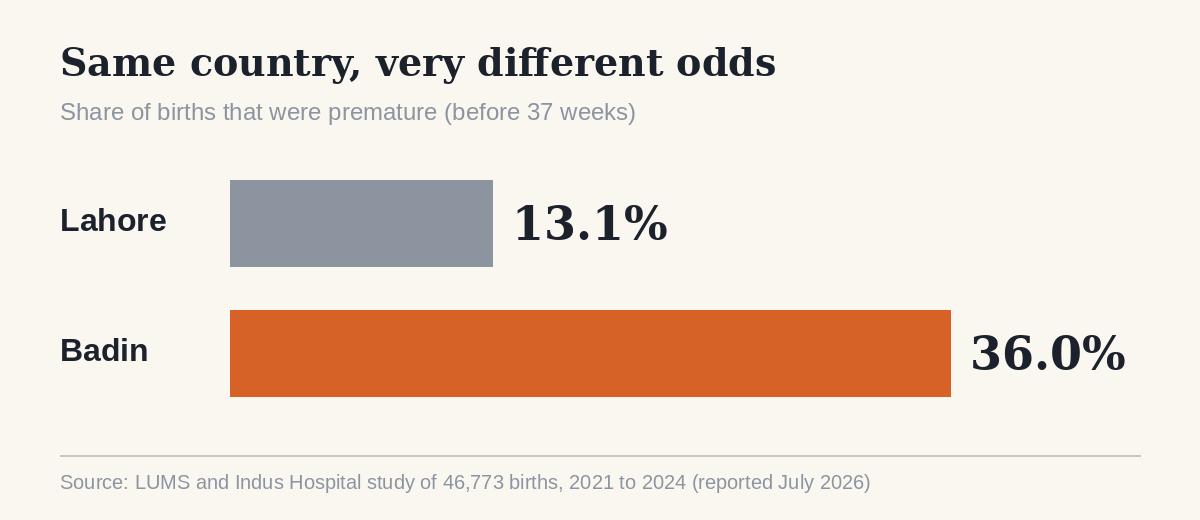
Badin’s rate swung from 27.6 percent in November to 46.9 percent in August. Almost every pregnancy there faces extreme heat, so a simple analysis cannot tell a hot summer apart from simply being in Badin. Seasonal infections, nutrition, and how patients get referred to hospitals all play a part too.
The heat was not cleared of blame, since one test still showed a small effect. But it got tangled up in something bigger, and the tangle is the story.
It is a map problem
Read together, the two studies say that temperature matters, but address matters more. The poorest districts are the hottest, and the poorest mothers are the hungry ones and the least equipped with clinics. Southern Punjab, the northern part of Sindh and Balochistan were identified areas of highest risk by the birth weight study.
Then there is the size of the country. Pakistan is now fifth in the world by population. UNFPA puts the average at 3.6 children per woman in Pakistan, the highest in South Asia, and says fertility has stopped falling as fast as it should. It ties that to high maternal deaths and weak care in remote areas, and also points to women who want family planning and can’t get it.
Set that beside thin clinic coverage and hotter summers, and the women at the bottom of the pile feel every heatwave and flood first.
The floods of 2022 provided some foretaste. Approximately 650,000 pregnant women were in the impacted areas, with 73,000 set to deliver within the next month. Over 1000 health facilities were damaged or destroyed in Sindh alone.
Ask a different question
We keep asking how many degrees it takes to raise the risk. Maybe the better question is who is left alone with the heat.
A woman near a cool, powered clinic, with a trained midwife and enough to eat, faces one kind of summer. A woman in a baking house, far from care and already underweight, faces another. Same thermometer reading. Very different odds.
All of this requires no miracle. Use heat warnings – identifying pregnant women and prioritizing the districts most affected. Clinics require power and cooling to keep operating during a flood or heat wave. Men and women should have genuine access to family planning, enabling women a certain measure of control over their pregnancies. Then there’s the data. Birth records broken down by district would stop a place like Badin from disappearing into a national average. A start has already been made, too. Aga Khan University is following 6,000 pregnant women in Sindh and Karachi.
Pakistan can’t cool the planet by itself. But it can choose which mothers get protected when the heat arrives, and the data now shows where to start.
Has a heatwave changed how your family handles a pregnancy? Tell me in the comments.
Sources: Adelaide University (birth weight study), Daily Times and ProPakistani (LUMS study), UNFPA Pakistan, Human Rights Watch, The Third Pole, Earth Journalism Network.
Aman Nadeem is a software engineering graduate and data analyst based in Lahore. Portfolio: https://amannadeem-portfolio.netlify.app/